Fractional Odds Explained: How to Read 5/1, 6/4 and 10/11 Betting Odds
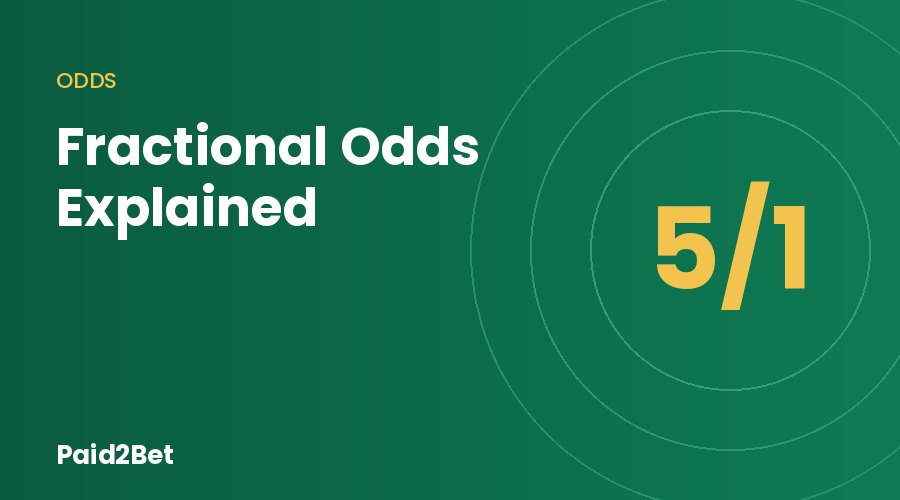
Fractional odds tell you how much profit you make compared with what you bet. The first number is what you win, the second is what you stake. At 5/1 (said "five to one") you win $5 for every $1, so a $10 bet wins $50 and you get $60 back with your stake. At 1/2 you win $1 for every $2, so a $10 bet wins $5.
They're the traditional British and Irish format, and you still see them in horse racing and at UK bookmakers. US sportsbooks show American odds instead, but the idea is the same once you know how to read the fraction. Converting between the formats takes one line of math, and we'll show it below with real prices.
How to read fractional odds
Read the fraction as "win this much for every this much." 6/4 means win $6 for every $4 you bet. 10/11 means win $10 for every $11. The top number (the numerator) is profit. The bottom number (the denominator) is stake.
If the first number is bigger than the second, like 5/2, the bet pays more than you risk. That's an underdog, or "odds against" in British betting talk. If the first number is smaller, like 4/6, you're risking more than you win. That's a favourite, or "odds on." And 1/1 is even money, usually written as "evens": bet $10, win $10.
You always get your original stake back on a winning bet. The fraction only describes the profit, which trips up a lot of bettors the first time they read odds this way.
How to calculate winnings from fractional odds
Multiply your stake by the fraction. That's your profit. Add your stake for the potential return, the total amount you'd get back.
At 5/4 with a $20 wager: 20 × 5 ÷ 4 = $25 profit, and $45 back in total. At 4/6 with $30: 30 × 4 ÷ 6 = $20 profit, $50 back. At 11/4 with $8: 8 × 11 ÷ 4 = $22 profit, $30 back.
| Fractional | $10 wins | Total return | Decimal | American |
|---|---|---|---|---|
| 1/3 | $3.33 | $13.33 | 1.33 | -300 |
| 1/2 | $5.00 | $15.00 | 1.50 | -200 |
| 4/6 | $6.67 | $16.67 | 1.67 | -150 |
| 10/11 | $9.09 | $19.09 | 1.91 | -110 |
| 1/1 (evens) | $10.00 | $20.00 | 2.00 | +100 |
| 6/4 | $15.00 | $25.00 | 2.50 | +150 |
| 2/1 | $20.00 | $30.00 | 3.00 | +200 |
| 5/1 | $50.00 | $60.00 | 6.00 | +500 |
| 10/1 | $100.00 | $110.00 | 11.00 | +1000 |
That 10/11 row is worth remembering. It's the standard spread price, the same bet American books show as -110. We cover that price in detail in what -110 means in betting.
Fractional odds and implied probability
Every price also says how likely the bookmaker thinks the outcome is. With fractional odds, divide the denominator (the second number) by the sum of both numbers to get the implied probability.
5/1 is 1 ÷ 6 = 16.7%. 6/4 is 4 ÷ 10 = 40%. 1/2 is 2 ÷ 3 = 66.7%. 10/11 is 11 ÷ 21 = 52.4%.
Add up the implied probabilities for every outcome in a market and you get more than 100%. On a game priced 10/11 each way, it's 104.8%. That extra is the bookmaker's margin, also called the vig or overround, and it's how they make money whichever side wins. Our guide to implied probability in betting shows how to strip it out and find a fair price.
That's also the answer to "is 7/1 better than 5/1?" It pays more, but it's less likely: 12.5% against 16.7%. A bigger number is never good value by itself. It's good value only if you think the real chance is higher than the price says.
How to convert fractional odds
You'll want to convert if you're comparing a UK price with a US sportsbook, or using a calculator that only takes one format.
Fractional to decimal
To convert fractional odds to decimal, divide the numerator by the denominator and add 1. 6/4 is 1.5 + 1 = 2.50. 5/1 is 5 + 1 = 6.00. 10/11 is about 0.909 + 1 = 1.91. Decimal odds include your stake, which is why you add the 1. Going the other way, subtract 1 and turn what's left into a fraction: 3.50 becomes 2.5, which is 5/2. There's more on the decimal format in decimal odds to American odds.
Fractional to American
If the fraction is bigger than 1 (an underdog), divide it and multiply by 100. 5/2 is 2.5 × 100 = +250. 7/1 is +700.
If the fraction is smaller than 1 (a favourite), divide 100 by the fraction and make it negative. 1/2 is 0.5, so 100 ÷ 0.5 = -200. 4/6 is 0.667, so -150. Evens is +100.
American odds use positive numbers for underdogs and negative numbers for favourites, pegged to $100 instead of $1, but the betting odds underneath are the same. If the plus and minus signs are new to you, start with how to read American odds.
Odd-looking fractions you'll run into
UK bookmakers stick to a ladder of familiar fractions, so some prices look strange at first. 8/13 is a favourite at about -163. 100/30 is about +333. 11/8 is +137.5. You'll also see 13/8, 15/8 and 9/4 in horse racing and football.
Don't try to memorize them. Run the same method: stake × fraction for profit, second number over the sum for probability. After a few races or matches, the common ones stick.
Where fractional odds are used
Fractional odds are commonly used in the UK and Ireland, especially for horse racing, and you'll still hear them in US racing and in phrases like "a hundred to one shot." Most of Europe, Canada and Australia use decimal odds. US sports betting odds are American odds, and that's what you'll see on Paid2Bet.
All three formats describe the same bet, and most betting sites let you switch the odds format in your settings. Pick the one you find easiest and convert the rest. For the bigger picture on how the formats fit together, our guide to how betting odds work is the place to start.
Practice reading prices
The fastest way to get comfortable with odds is to use them. On the Paid2Bet Bet page you can tap any line and the slip shows what your stake would win, so you can check your own math against it with a free balance.
You must be 21 or older to play. Gambling problem? Call 1-800-GAMBLER.
FAQ
What are better odds, 5/1 or 7/1?
What does 8/1 odds mean?
How do you calculate probability from fractional odds?
What does +700 odds mean in fractional odds?
Build a streak today
15 in a row = $100 · 21 in a row = $1,500 · Free to play.
 Implied Probability in Betting: How to Calculate It From Any OddsOctober 18, 2026
 How to Read American Odds: Plus, Minus and What You WinOctober 18, 2026
 Decimal Odds to American Odds: The Formulas, a Conversion Table and ExamplesOctober 14, 2026